

How to Predict NFL Game Outcomes Like a Data Pro
- Ern

- May 1
- 10 min read

Most bettors approach NFL picks the same way every week: gut feel, favorite team bias, and whatever the loudest analyst said on Sunday morning television. The result is a losing record that feels random but is actually predictable in its failure. The NFL betting market is not purely a coin flip. There are measurable patterns, exploitable inefficiencies, and data-driven methods that consistently outperform casual guesswork. This guide walks you through exactly how to use advanced stats, odds movement, and disciplined process to make smarter picks and build a repeatable edge over the long haul.
Table of Contents
Key Takeaways
Point | Details |
Models outperform intuition | Machine-learning methods with key stats can predict NFL outcomes better than fixed formulas or gut picks. |
Not all metrics matter | Focus on points scored/allowed and efficient odds movement for the biggest prediction gains. |
Markets show exploitable signals | Watch for moneyline odds drifts in the days before kickoff to spot value. |
Discipline beats chasing trends | Consistent, documented strategies outperform short-term, reactionary betting. |
Expert support pays off | Supplementing your process with expert analysis can help you win more bets with less effort. |
Understanding the challenges of predicting NFL outcomes
NFL games are notoriously difficult to predict, and that difficulty is not accidental. The league features extraordinary parity, frequent upsets, and a betting market populated by sharp money and sophisticated algorithms. Most casual bettors assume that watching every game gives them an edge. It rarely does.

One of the most persistent misconceptions is the idea of the “sure thing” pick. No such thing exists in a 32-team league where injuries, weather, and game script can flip a result in the final two minutes. Another common trap is recency bias, which means overweighting what a team did last week and underweighting the broader body of evidence. A team that covered by 21 points against a weak defense is not suddenly a different franchise.
What makes the market particularly tricky is that it is designed to be efficient. Sportsbooks employ sharp analysts and real-time data systems to set lines that balance action. However, efficiency is not perfection. Research on exploiting odds drifts shows that systematic patterns do exist. A Claremont thesis analyzing 2020 to 2024 high-frequency odds data found that NFL moneyline odds can show systematic, predictable drifts through the week leading up to kickoff, consistent with imperfect efficiency or exploitable market mechanics.
“The market is often efficient, but not always. Knowing when and where inefficiencies appear is the real skill.”
Here are the most common myths that cost bettors money each week:
The hot team myth: A team on a three-game win streak is not automatically a good bet. Strength of schedule matters far more than streak length.
The star player override: One elite quarterback does not cancel out a weak offensive line or a leaky secondary.
The home field premium: Home field advantage is real but often overpriced in the market, especially in dome stadiums or neutral-site matchups.
The revenge game narrative: Teams motivated by a previous loss make for compelling stories but unreliable picks.
Understanding these pitfalls is the foundation. From here, the focus shifts to what actually produces accurate predictions.
What data you need: Key stats and indicators
Knowing which data points to prioritize is where most bettors fall short. They either track too many variables and get lost in noise, or they rely on basic stats like total yards and win-loss records that carry limited predictive weight.
Advanced prediction systems zero in on a specific set of high-impact metrics. According to a machine-learning model study that outperformed the Pythagorean approach, points scored and points allowed were the most influential features as measured by SHAP values, a method used in machine learning to determine how much each variable contributes to a prediction. This is not a surprise to experienced analysts, but it is a direct contradiction to bettors who obsess over passing yards or third-down conversion rates as primary inputs.
The most valuable team stats for NFL prediction break down into three tiers:
Tier | Metric | Why it matters |
Tier 1 (High impact) | Points scored per game | Direct measure of offensive output |
Tier 1 (High impact) | Points allowed per game | Direct measure of defensive quality |
Tier 2 (Moderate impact) | Turnover differential | Reflects ball security and field position |
Tier 2 (Moderate impact) | Red-zone execution rate | Measures scoring efficiency in key situations |
Tier 3 (Contextual) | Weather conditions | Relevant in outdoor stadiums during late season |
Tier 3 (Contextual) | Injury report status | Critical for skill position players and quarterbacks |
Team form over the last four to six games provides useful context, but it should never override a full-season trend. Injuries matter most when they affect quarterbacks, starting offensive linemen, or cornerbacks covering elite receivers. Weather becomes a genuine factor when wind exceeds 15 mph or precipitation is heavy, as it suppresses passing efficiency and scoring totals.
Reliable data sources include Pro Football Reference for historical stats, ESPN’s injury reports updated throughout the week, and sharp-money tracking tools that show where professional bettors are placing their action. AI model approaches have also become increasingly relevant, with machine learning systems processing thousands of data points to identify patterns human analysis might miss.
Pro Tip: Limit your primary inputs to five or six high-confidence metrics. More variables do not automatically produce better predictions. They often introduce noise that dilutes the signal from your strongest indicators.
Step-by-step guide: How to predict NFL game outcomes
Once you know which data matters most, you’re ready to follow a clear process for making smarter picks. This is not about finding a magic formula. It is about applying repeatable logic consistently, week after week.
Step 1: Gather essential team data and latest odds
Start by pulling current season stats for both teams: points scored per game, points allowed per game, turnover differential, and red-zone efficiency. Cross-reference these against the opening moneyline odds for the matchup. The opening line reflects the sportsbook’s initial read on the game. It is your baseline.
Step 2: Track odds movement through the week
Lines move for two primary reasons: sharp money (professional bettors placing large wagers) and public money (casual bettors loading up on popular teams). NFL moneyline odds can show systematic, predictable drifts through the week. If a line moves against the public betting percentage, that is often a sign that sharp money disagrees with the crowd. That disagreement is worth noting.
Step 3: Weigh key stats in line with proven model priorities
Apply the tier system from the previous section. Start with points scored and allowed. Then layer in turnover differential and red-zone execution. Only after establishing those baselines should you factor in contextual variables like weather or injuries. Advanced prediction strategies follow this same hierarchy, prioritizing structural performance data over situational noise.
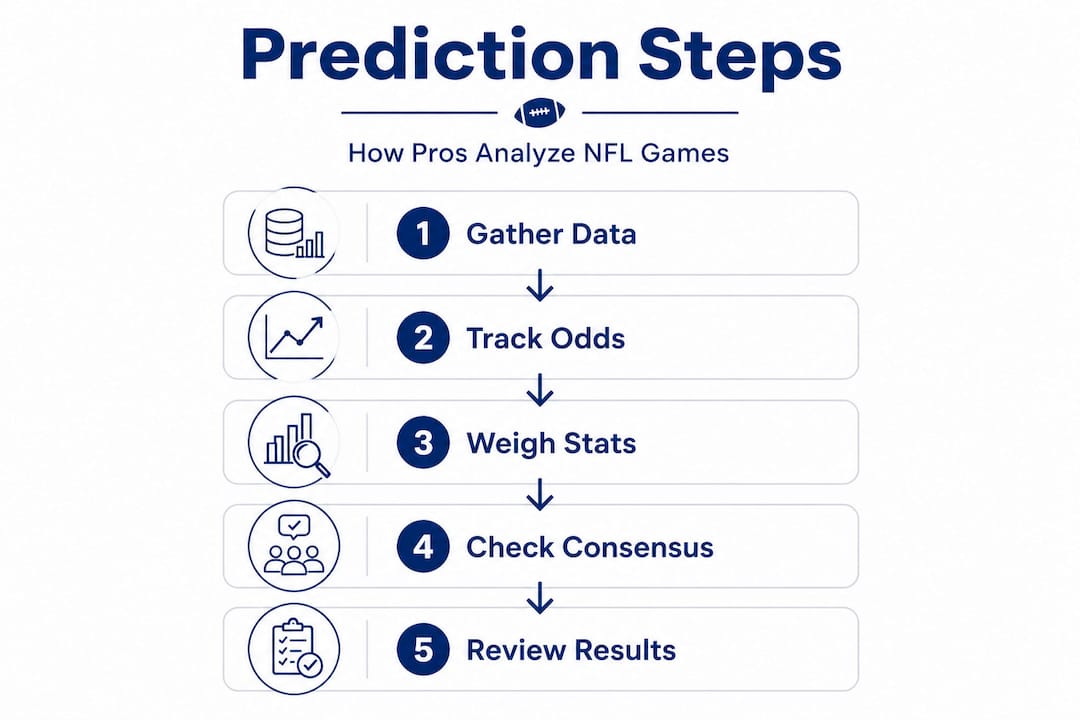
Step 4: Compare your prediction versus consensus and public data
Once you have a projected winner based on your data, check it against the public consensus. If 75% of bettors are on one side and your data points to the other, that is a potential value opportunity. Machine-learning models using a broad set of team performance indicators consistently outperform fixed-formula baselines, and a key reason is their ability to identify when public sentiment diverges from underlying performance data.
Step 5: Record your results and refine your approach
This step is the one most bettors skip, and it is arguably the most important. Keeping a detailed log of every prediction, the reasoning behind it, and the outcome lets you identify where your process is strong and where it breaks down. Over a 17-game season, even a modest improvement in accuracy compounds into significantly better results.
Here is a quick comparison of two approaches to NFL prediction:
Approach | Data inputs | Accuracy potential | Consistency |
Gut feel / narrative | Media takes, recent games | Low | Unpredictable |
Data-driven model | Points, turnovers, odds movement | High | Repeatable |
Pro Tip: Be patient with your process. A well-constructed method that goes 3-4 in a given week is not broken. Consistency over a full season is the real benchmark. Chasing losses by abandoning your system is the fastest way to erase any edge you have built.
Avoiding common pitfalls in NFL game prediction
Knowing the right process is only part of the puzzle. Many bettors trip up in ways that are entirely avoidable with awareness and discipline. These mistakes are not rare. They show up every single week across the betting public.
The most costly mistakes in NFL prediction:
Chasing last week’s results: A team that blew out a weak opponent is not automatically a strong pick the following week. Context matters. Who did they play? What was the game script?
Ignoring late-breaking injury news: An injury report filed Wednesday is not the same as Thursday’s update. Skill position injuries, particularly at quarterback or wide receiver, can shift a line by two to three points. Always check the final injury report before placing any wager.
Overvaluing home-field advantage: Home teams win at a higher rate historically, but the market already prices this in. Paying a premium for home field in a tight line often means you are getting negative expected value.
Reacting to public overreactions: After a big upset, the public tends to overcorrect. The losing team gets undervalued and the winning team gets overvalued. This is exactly where market drifts in NFL odds create opportunities for disciplined bettors.
Skipping the tracking process: Without a record of your picks and reasoning, you cannot improve. You are essentially starting from zero every week.
“The bettors who last in this game are not the ones who pick the most winners in a single week. They are the ones who maintain process discipline long enough to let the edge compound.”
Research reinforces this point directly. NFL moneyline odds can show systematic, predictable drifts through the week leading up to kickoff. Bettors who understand this pattern and wait for the right entry point consistently outperform those who lock in picks on Sunday morning based on whatever narrative dominated the previous week’s coverage.
The antidote to all of these pitfalls is the same: disciplined, documented, data-first decision-making. It is not glamorous. But it works.
Perspective: Why most NFL prediction models miss the mark (and what actually works)
Here is the uncomfortable truth about most publicly available NFL prediction models: they are built to impress, not to win. They incorporate dozens of variables, produce confidence percentages down to the decimal, and generate content that feels authoritative. But complexity is not accuracy. Most of these models fail because they chase too many inputs and end up amplifying noise rather than isolating signal.
The models that actually hold up over time share a few characteristics. They prioritize a small number of high-impact variables. They account for market movement rather than treating the line as a fixed truth. And they are updated continuously based on documented outcomes, not rebuilt from scratch every time they have a bad week.
At Ern’s Edge, the biggest breakthroughs in prediction accuracy did not come from adding more data. They came from removing data that was creating false confidence. Metrics like total offensive yards, time of possession, and third-down conversion rates feel meaningful but carry far less predictive weight than points scored, points allowed, and turnover differential. Cutting those secondary variables sharpened the signal considerably.
The other factor that separates lasting success from popular but ineffective methods is documentation. Bettors who track every pick, every line, and every outcome build a feedback loop that improves their process over time. Those who do not track are essentially guessing, regardless of how sophisticated their pre-game analysis looks on paper. Cutting through prediction noise is less about finding new data and more about having the discipline to trust the data you already have.
The market will always generate compelling narratives. A quarterback controversy, a revenge game, a weather event. The bettors who win consistently are the ones who evaluate those narratives against the underlying numbers and have the discipline to fade the story when the data says to. That is the real edge.
Take the next step with expert NFL predictions
If you want to apply everything covered in this guide without spending hours each week pulling stats and tracking line movement, Ern’s Edge does that work for you. With a 361-182 combined record across 2024 and 2025, the platform delivers data-driven NFL picks built on the exact model-first approach outlined here. Every recommendation is grounded in points scored and allowed, turnover rates, red-zone execution, and real-time odds movement, not media narratives or gut reactions.
Explore the NFL game-winner packages to find the level of access that fits your betting volume and goals. Whether you want full-season support or targeted weekly picks, the platform is built for bettors who take their results seriously. Check out the pricing and subscription options and see which plan gives you the consistent, model-driven edge you have been looking for. Every package comes with a 100% satisfaction guarantee, so the only risk is staying with the approach that has not been working.
Frequently asked questions
What are the most reliable stats for predicting NFL games?
Points scored and points allowed are the most predictive stats for NFL game outcomes according to advanced models, as SHAP analysis confirms they carry the highest feature importance in machine-learning prediction systems. Turnover differential and red-zone execution rate are strong secondary indicators worth tracking consistently.
Can you really beat the NFL betting market?
While the market is generally efficient, research shows that NFL moneyline odds drift predictably during the week before kickoff, creating exploitable windows for disciplined, data-first bettors who know when and where to act.
How often do advanced models correctly predict NFL winners?
Top machine learning models have achieved strong prediction accuracy, with one feedforward neural network study reporting an R-squared value of 0.891, meaning the model explained nearly 89% of the variance in game outcomes using team performance data.
Does following public betting trends help predict games?
Public consensus is useful for identifying overvalued teams, but following crowd sentiment alone is not a reliable strategy. Data-driven analysis consistently outperforms public opinion, particularly when sharp money is moving in the opposite direction.
What’s a quick way to avoid mistakes in NFL prediction?
Track every prediction you make along with your reasoning, and review your record at the end of each week. Bettors who document their process identify their own blind spots far faster than those who only remember their wins.
Recommended


Comments